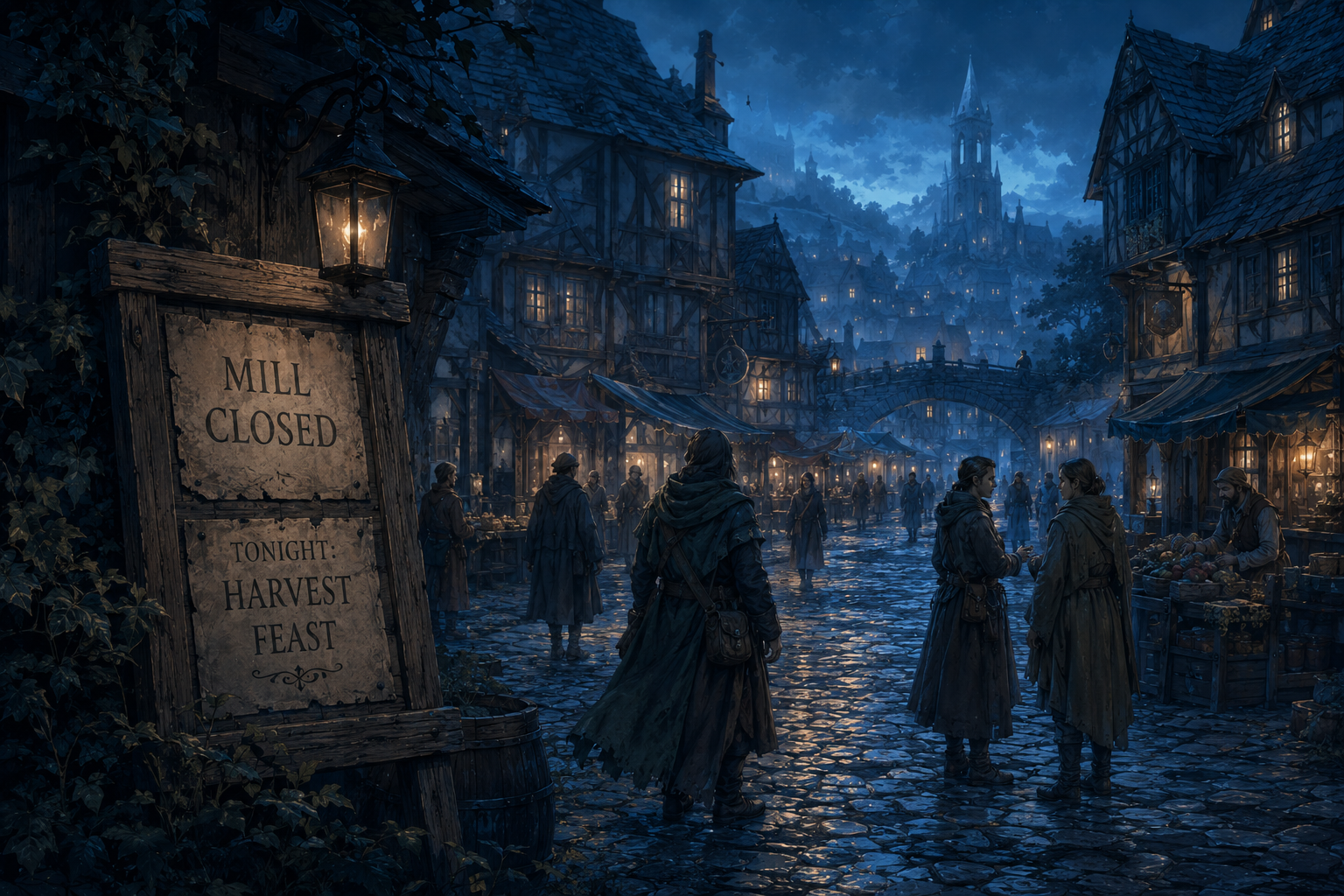
How to Make a Town Feel Alive in 20 Minutes of Prep
A town does not feel alive because the Game Master wrote twenty pages of history. It feels alive because the players can sense that people live there. They hear the bell ring. They see the baker scraping flour from his sleeves. They notice the guards are tired, the tavern has gone quiet, and the old woman at the well does not want to talk after sunset.
You are not trying to build a complete settlement in 20 minutes. You are trying to create signs of life. A living town has motion, pressure, routines, needs, and consequences. It was doing something before the adventurers arrived, and it will keep doing something if they decide to walk away.
Start With the Town’s Current Problem
The fastest way to wake a town up is to give it a problem that is happening right now. Not a problem from ancient history. Not a lore dump about the kingdom’s founding. Something that has people whispering in the market this week. Something that makes the tavern louder than usual, or quieter than usual. Something that causes a shopkeeper to close early, a priest to lie, or a guard to keep glancing toward the woods.
Write one sentence: This town is currently dealing with ______. The well water tastes like iron. The mill has been closed for three days. A beloved hunter came back from the woods without his shadow. A wedding is tomorrow, and half the town thinks it should not happen. The tax collector arrived with soldiers. The local saint’s statue has started weeping mud. You do not need the whole answer yet. You just need pressure.
Create Three People Who Want Different Things
A town feels alive when the people inside it are not all waiting to hand the party the same quest. Give yourself three NPCs with three different wants. They do not all need to be enemies. In fact, it is usually better if they are not. One may be afraid, one may be desperate, and one may be making everything worse while sincerely believing they are helping.
A useful trio is the public face, the desperate local, and the complicating force. The public face gives the official story. The desperate local gives the emotional cost. The complicating force turns the situation sideways. For each one, write their name, their role, what they want, and what they will do if ignored. That last part matters. It keeps the town from freezing in place while the party shops for rope.
Add One Daily Rhythm
Players notice routines. They may not consciously think, “Ah, this settlement has a convincing social rhythm,” but they will feel it when the town has habits. Bells ring three times a day. Fishermen return at dusk. Children race through the morning market. Everyone shutters their windows before sunset. The baker gives unsold bread to the poor at sundown. The guards change shifts just as the tavern begins to fill.
Then break the rhythm. Every day, the noon bell rings. But today, it does not. Every evening, the fishermen come home singing. But tonight, they return silent with empty nets. Every market day, children chase each other between stalls. But this morning, no children are outside. A rhythm says, “Life happens here.” A broken rhythm says, “Something is wrong.”
Give the Town Two Places With Personality
You do not need a full town map before the session. You need two places the players can remember. One should be social: a tavern, market, shrine, bathhouse, bridge, public square, guildhall, or busy street. The other should point toward the problem: the sealed mill, the strange well, the old road, the chapel basement, the ferry landing, the burned watchtower.
For each place, give yourself one sensory detail and one social detail. The Bent Nail Tavern smells like smoke, onions, and wet wool, and the locals go quiet whenever strangers mention the woods. Saint Orla’s Well has cold mist clinging to the stones even in summer, and children dare each other to look into it after dark. That is enough. The players do not need a full floor plan. They need something to picture and something to poke.
Prepare Three Rumors, But Make Only Two True
Rumors make a town feel like it has opinions. They let you show fear, prejudice, misunderstanding, superstition, and half-right conclusions without stopping the game for exposition. The trick is to avoid making rumors into a perfect quest log. If every rumor is cleanly true, the townspeople start to feel like labeled drawers full of clues.
Write three rumors: one true, one partly true, and one false but believable. “The miller’s daughter saw something crawling out of the flour sacks.” “Old Man Reed has been feeding wolves behind his house.” “The priest knows more than he’s saying.” The false rumor should still tell the party something useful about the town. Maybe it reveals who people mistrust. Maybe it points toward an old fear. Maybe it shows how badly everyone wants a simple explanation.
Add a Clock
This is the step that does the most work. If the party does nothing, something should still happen. The town should not wait politely in a glass box until the adventurers select the correct dialogue option. People panic. People lie. People get tired of waiting. People make brave, stupid decisions because they have families, debts, grudges, and crops in the field.
Use a simple three-step clock. First, something strange or tense happens. Second, someone makes a bad decision. Third, the problem becomes impossible to ignore. In a town with a haunted mill, the mill starts turning with no wind. Then Mara pays local teenagers to break in and recover supplies. By sunset, the mill bell rings and someone comes out changed. Now the town is moving.
The 20-Minute Prep Checklist
- Minute 0-3: Current Problem
- What is happening in town right now?
- Why do people care?
- Minute 3-8: Three NPCs
- Who is the public face?
- Who is personally desperate?
- Who complicates the problem?
- What will each one do if ignored?
- Minute 8-11: Daily Rhythm
- What happens every day in this town?
- What is different today?
- Minute 11-15: Two Locations
- What is one social location?
- What is one problem-related location?
- What sensory detail makes each place memorable?
- Minute 15-18: Three Rumors
- What rumor is true?
- What rumor is partly true?
- What rumor is false but believable?
- Minute 18-20: Town Clock
- What happens first if the party does nothing?
- Who makes a bad decision next?
- What makes the problem impossible to ignore?
Download and print this 20-minute check list and keep it in your binder for emergencies!
Example Town Built in 20 Minutes: Greywick Crossing
Greywick Crossing is currently dealing with a bridge that has started whispering the names of people who will die soon. That is not a full adventure yet, but it is enough to make the place breathe. Merchants need the bridge open. Parents want their children kept far away from it. The old and guilty keep finding excuses to stand nearby, listening for names they dread or names they miss.
The public face is Mayor Elsbeth Crowe, who wants the bridge kept open because trade is all the town has. If ignored, she will suppress panic by force. The desperate local is Nell the Ferryman, who wants people to stop using the bridge. If ignored, she will sabotage the road to redirect travelers. The complicating force is Corvin Hale, who wants to hear his dead wife’s name from the bridge again. If ignored, he will start making offerings beneath it.
Every morning, wagons line up before dawn to cross the bridge. But today, nobody wants to be first. The Split Tankard is a tavern built from two old riverboats. It smells of tar, ale, and damp rope, and everyone inside pretends not to listen when the bridge is mentioned. The Old Stone Bridge gathers frost beneath its arches even in warm weather. Names can be heard in the water below, and birds refuse to fly over it.
The rumors are already moving. Some say the bridge only speaks the names of liars. Some say the first mason buried his brother inside the center arch. Some say the river is not water after midnight. If the party does nothing, the bridge whispers a child’s name at sunset. By morning, the child is missing. By the next evening, the town splits between those who want the bridge destroyed and those who will kill to defend it.
Life Comes From Pressure, Not Lore
A living town does not need exhaustive detail. It needs people in motion. It needs a current problem, a few motivated locals, a broken routine, a couple of places worth remembering, some unreliable chatter, and a reason things will get worse if nobody acts.
The goal is not to know everything about the town. The goal is to make the players feel like they walked into a place that was already breathing before they arrived. Twenty minutes is plenty of time to do that. Start with pressure. Add people. Break one normal thing. Then let the town move.