Stop Making Combat Only About Hit Points
Combat wakes up the table.
Dice hit the tray. Someone straightens in their chair. The wizard starts reading a spell very carefully. The fighter suddenly remembers every bonus they have ever earned.
Combat has weight because it asks an urgent question:
What are you willing to risk right now?
That is too useful to waste on fights that only say, “Here are some enemies. Reduce them to zero.”
There is nothing wrong with a simple brawl now and then. Sometimes the goblins really are just goblins, and everyone is happy to roll damage for a while. But the best combat encounters do more than drain hit points.
They reveal something.
A fight can show what kind of person a character is. It can expose the truth about a place. It can hint that the villain is closer than the party thought, or that the monster is not the real monster after all.
Combat is not a break from the story.
Combat is what happens when the story draws a knife.
Ask What the Fight Reveals
Before you place enemies on the map, ask one question:
What does this combat reveal?
Not every fight needs a shocking twist. Please do not make every wolf secretly a cursed prince. But every fight can leave behind a little meaning.
Maybe the bandits know one of the characters by name.
Maybe the skeletons refuse to attack anyone wearing a certain holy symbol.
Maybe the goblins have clean military boots.
Maybe the monster is guarding something instead of hunting.
These details turn combat into a question. And questions are what keep players leaning forward.
The goal is not to stop the action and explain lore. The goal is to let the fight leak information.
A zombie with a wedding ring says more than a paragraph of backstory.
A burned chapel where the enemies refuse to cross the altar line tells the players something happened here.
A mercenary who tries to capture the cleric alive instead of killing them tells the party someone gave very specific orders.
One good detail can change the whole shape of a fight.
Give Enemies a Reason to Fight
A lot of flat encounters happen because the enemies only exist inside initiative.
They wait in a room. The party arrives. They attack. They fight to the death for no clear reason.
Most enemies should want something besides “combat.”
A bandit wants coin, food, revenge, or leverage.
A cultist wants the ritual finished.
A wolf wants the party away from its den.
A guard wants to survive this shift without being blamed for whatever disaster the adventurers are about to cause.
Once the enemy wants something, the encounter starts breathing.
Bandits might run when the first one drops because dying in a ditch was never the plan. Cultists might throw themselves in front of the altar because the chant must continue. A wolf might attack the torchbearer, not because it understands party roles, but because fire is the threat it fears most.
This does not make combat less exciting. It makes it feel alive.
The players can still fight.
But now there is something to notice.
Let the Battlefield Have a Memory
The place where the fight happens should feel like it existed before the characters arrived.
This is one of the easiest ways to make combat reveal setting without pausing for a lore lecture.
Do not tell the players the region has suffered from years of religious war.
Put two broken holy symbols in the mud, both smashed by the same hammer.
Do not explain that the baron is secretly arming goblins.
Let the party find goblin arrows fletched in the baron’s colors.
Do not announce that old magic reacts to blood.
Let the stones hum the first time someone is wounded.
The battlefield can speak. The road can speak. The cave can speak. The corpse half-buried under the roots can definitely speak, though hopefully not literally every time.
You do not need a giant description. Just add evidence.
A dining hall with animated armor is fine.
A dining hall where the armor attacks only the noble family, ignores the servants, and stops moving when someone speaks the old house motto is suddenly telling a story.
Now the players are not just asking, “How do we beat the armor?”
They are asking, “What did this family do?”
That is the good stuff.
Make Tactics Reveal Character
The way enemies fight tells the players who they are.
A starving thief should not fight like a professional soldier. A cornered animal should not fight like a death cultist. A proud knight should not fight like a paid assassin, unless you want the players to notice that something is wrong.
You only need one behavioral rule.
The bodyguard always moves between danger and their charge.
The predator tries to drag one victim away.
The coward strikes from cover and runs when wounded.
The fanatic smiles through the blood and keeps crawling toward the altar.
The veteran calls targets by role: “The healer first.”
Suddenly, the stat block has a personality.
This also makes the fight easier to run. When you are unsure what an enemy should do next, ask what they care about.
Survival?
Revenge?
The ritual?
Their commander?
The treasure?
Being seen as brave?
That answer usually tells you their next move.
Add One Thing That Damage Cannot Solve
If every meaningful problem in a fight can be solved with damage, then damage becomes the only language anyone speaks.
So put something in the scene that invites another kind of action.
A bell that can be rung.
A cage that can be opened.
A bridge rope starting to snap.
A ritual circle growing brighter each round.
A frightened horse dragging a wagon toward a cliff.
A witness hiding under the table.
These do not need complicated mechanics. They just need possibility.
The rogue cuts the rope. The cleric grabs the child. The fighter holds the door. The bard shouts the enemy captain’s real name across the courtyard. The druid calms the horse instead of casting another spell.
That is when combat becomes memorable.
Not because the math was perfect.
Because someone made a choice.
Free DM Resources:
Here are a couple easy to print and use pdfs for you to use. They are a worksheet and a few cards. They help guide you into building better encounters for your players.
Let the Truth Arrive During the Fight
Do not save every interesting clue for after initiative.
Sometimes the best moment is when the players realize, mid-fight, that they misunderstood the scene.
The party thinks they are being ambushed by robbers on a bridge.
Then one attacker shouts, “Do not let them cross!”
Another shoots the mule instead of the wizard.
A third, bleeding badly, screams, “You fools, we are trying to keep it contained!”
Now the fight means something different.
Maybe the bridge guards are enforcing a quarantine. Maybe the land beyond is cursed. Maybe the party is carrying something dangerous without knowing it.
The players are still in danger, but now they are also thinking.
That is the sweet spot.
A good mid-fight reveal does not need a villain monologue. It can be messy and quick.
The blood runs uphill.
The monster recoils from one character’s holy symbol.
The bandits all have the same prison brand.
The enemy commander recognizes the party’s employer and looks betrayed.
Halfway through the fight, someone at the table should be able to say:
“Wait. Something is wrong here.”
That sentence is gold.
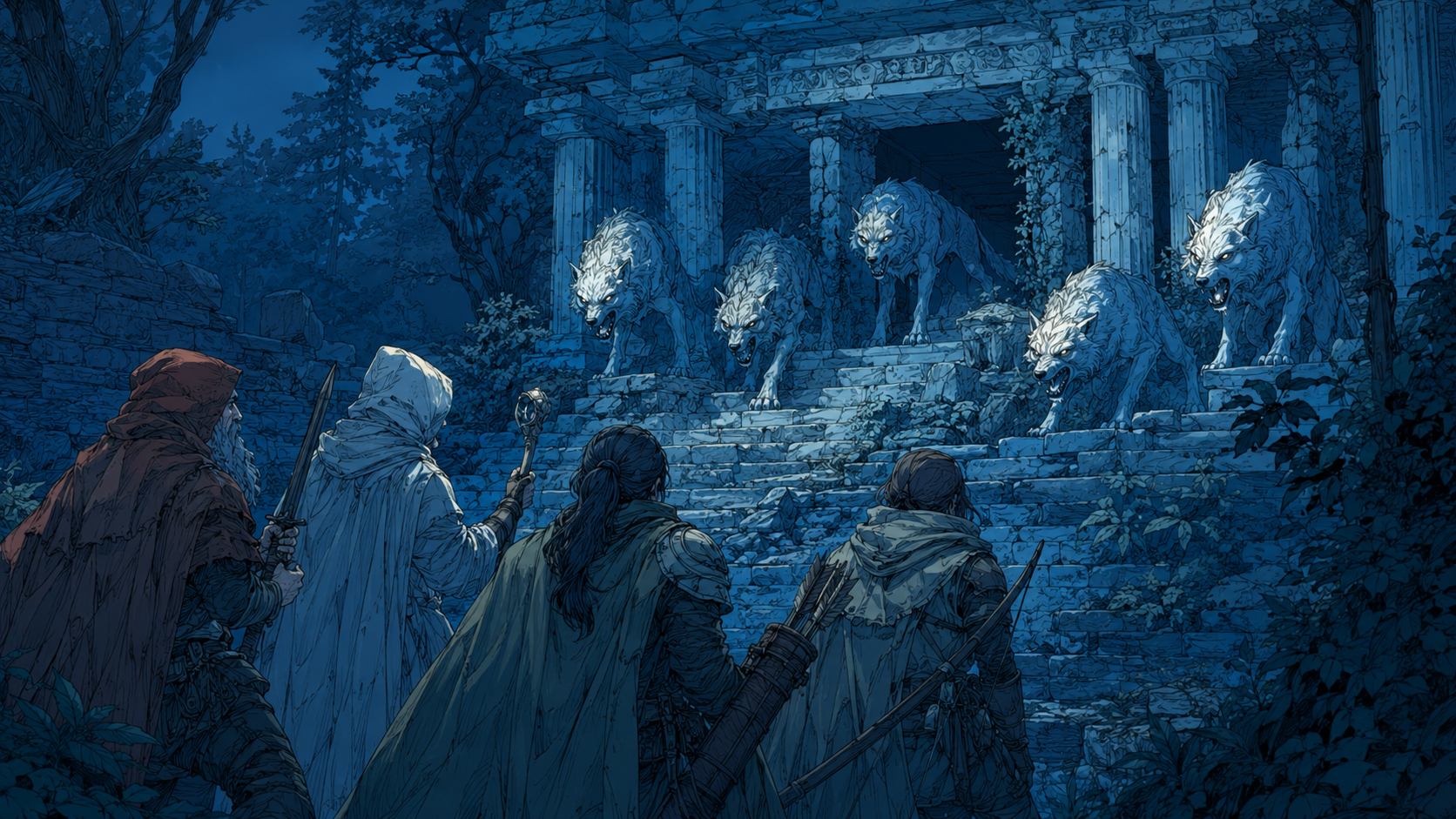
A Simple Example: The Wolves at the Shrine
Take a basic wilderness encounter.
The party finds wolves near a broken roadside shrine.
In the dull version, the wolves attack. The party kills them. Maybe someone takes a pelt. Everyone moves on.
Now let the encounter speak.
The wolves are circling the shrine, growling whenever anyone gets too close. They look thin and desperate. One has old prayer beads tangled around its neck.
If the party approaches with weapons drawn, the wolves attack. But they do not chase anyone who backs away from the shrine.
Then, during the fight, the first blood spilled on the shrine stones makes the ground tremble.
Now the scene has questions.
Why are the wolves guarding the shrine?
Why do they fear the stones?
Who put prayer beads on a wolf?
What is sleeping under the road?
You have not scripted an encounter. You have not forced a moral dilemma.
You have simply added meaning.
Maybe the party kills the wolves and later learns they were the last warning left by a dead order of rangers. Maybe the druid calms them. Maybe the cleric recognizes the beads. Maybe the barbarian bleeds on the shrine and wakes something that should have stayed buried.
That is not a railroad.
That is a loaded moment.
Where Table Tools Can Help
You do not need fancy terrain to make combat meaningful, but physical pieces can help players see the battlefield as more than empty squares.
A cracked altar, wagon, cage, bridge, campfire, ruined wall, or strange statue gives the players something to notice and touch.
This is a natural spot for affiliate links to things like reusable battle mats, scatter terrain, dry-erase cards, condition rings, initiative trackers, or clue tokens.
Keep it helpful, not pushy. The point is not “buy this to make combat good.”
The point is:
A few reusable table tools can make story-rich combat easier to see, run, and remember.
The Smallest Fix: Add One Reveal
You do not need to rebuild how you design combat.
Start with one reveal.
One enemy who wants something.
One battlefield detail that implies history.
One object that damage cannot solve.
One mid-fight clue.
One consequence that follows the party out of initiative.
That is enough.
A fight does not need to become a novel. It just needs to leave a mark.
Because the combats players remember are not usually remembered for the exact damage rolls.
They remember the wolves protecting the shrine.
The goblins with royal steel.
The ghost who was not angry, only ashamed.
The villain who knew their names.
That is when combat becomes more than a resource drain.
That is when the story draws blood.